
Category Archives: Fun Savvy

Reading Is Like Breathing To Me


Reading 2

I can barely remember a time in my life when I wasn’t able to read.  Reading means as much to me as breathing; one without the other is unthinkable.

Although I read many genres, my favorite is history. It’s difficult to say how my love of history originated. I was raised in an extended family with up to five generations regularly gathering for Sunday dinners. I heard endless tales about how great life used to be before modern morals screwed up society. Reading history was a useful method for fact-checking that glorious past.

It is easier to explain why I love military history. I’m a contrarian.  I was raised as a Mennonite, a Protestant sect that is pacifist.  Studying military history appealed to me as a protest against a patriarchal society that set stifling boundaries on women’s expectations. After all, military people get to fight back and sometimes win.

I began reading about the American War of Independence before moving on to our Civil War.  One of the best accounts of the Civil War is Battle Cry of Freedom, by James McPherson. It’s a “must read” for anyone interested in that war.

A source on southern life in the Civil War is Mary Chestnut’s Civil War, edited by C. Vann Woodward.  Mary Chestnut was a close friend of Varina Davis, wife of Jefferson Davis. Her memoir is full of political intrigues as well as the deprivations caused by the Yankee blockade.

Later I read about World War I flying aces. The top ace of the war was Baron Manfred von Richtofen, the Red Baron. But my favorite is Oswald Boelcke, the ace who commanded the jasta or flying circus before Richtofen. The last commander of that jasta, by the way, was Herman Goering of WW II infamy.

The biography of Boelcke illustrates an important point about history. Perspectives change. The original 1932 version by Professor Johannes Werner was published as the Weimar Republic tottered and the Nazis were close to taking power. The biography is full of jingoistic exhortations to German schoolboys to be loyal sons to their parents and the Reich. The English translation, Knight of Germany, includes the Professor’s rhetoric, which may be unsettling for some readers. The jingoism obscures the fact that Oswald Boelcke was a respected man who originated fighter pilot tactics that are still in use.

Eventually I moved on to reading about World War II, European Theater of Operations. A favorite author is Carlo D’este who writes well and includes extensive annotated endnotes.  I’ve also read scores of memoirs ranging from field marshals to French Resistance fighters. Memoirs are a great way for survivors to settle old scores against their enemies, including occasionally, the opposing side in the war.

I recommend reading history as the best method for gaining perspective on life. What we live through every day, good and bad, has happened before. History shows us how to cope with the bad and work toward the good.

About Norma Shirk

Norma started her company, Corporate Compliance Risk Advisor, to help employers create human resources policies for their employees and employee benefit programs that are appropriate to the employer’s size and budget. The goal is to have structure without bureaucracy. Visit Norma’s website: www.complianceriskadvisor.com/.

Like what you’ve read? Feel free to share, but please… Give HerSavvy credit. Thanks!


1 Comment

Filed under Fun Savvy, Self Savvy

Artist Tech

Renee's Tomatoes

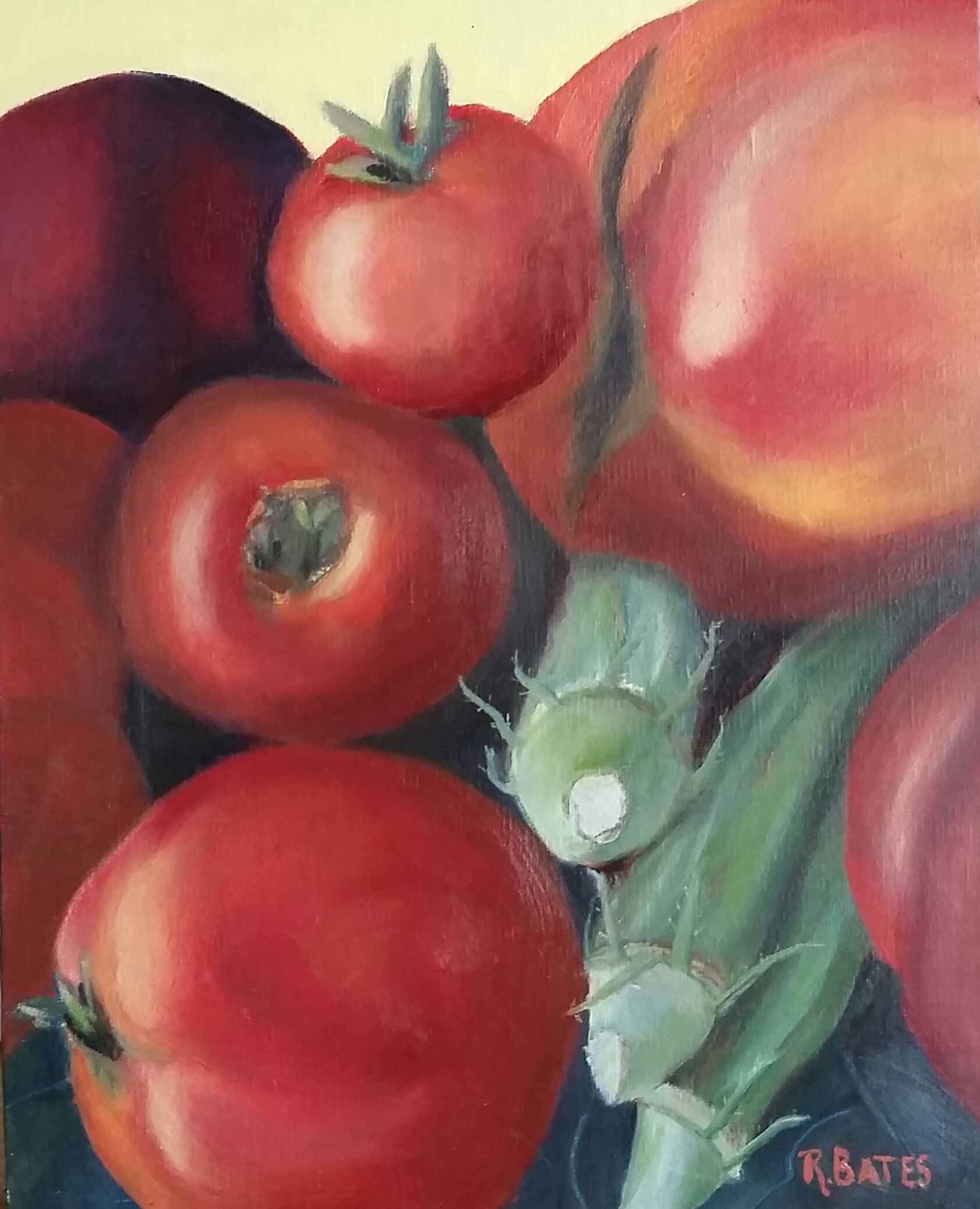
Spineless? Never!, 8” x 10” oil, © Renée Bates

As a painter, I use technology for capturing the light, or a moment in time.  I work as a plein air and studio painter.  Plein air is a term defined as pertaining to a manner or style of painting developed chiefly in France in the mid-19th century, characterized by the representation of the luminous effects of natural light and atmosphere as contrasted with the artificial light and absence of the sense of air or atmosphere associated with paintings produced in the studio.  Plein air can also be defined as designating a painting executed out of doors and representing a direct response to the scene or subject in front of the artist.  Lastly, a plein air painting is defined as having the qualities of air and natural light.

The business of “chasing the light,” as the sun moves across a scene, can make an artist crazy or in the least, make for a poor painting.  The “values,” or light and dark bits, are what make the thing read, even more than the color.  If you cannot capture it all quickly, you will lay out a painting, work it for a bit, then take a photograph and finish in the studio.  Technology is most helpful here.  The artist of former centuries had to work fast, or they had photographic memories.

I am probably most grateful for cell phones with quality cameras. A photography instructor recently said, “The best camera is the one you have with you.”  True. I regularly capture wildlife shots and beautiful horticulture with my phone camera. While it doesn’t get great detail at far distances, it does afford me many action shots.

When setting up plein air, I will often look through the lens at a scene for scale or, take a photograph and use the cropping tool to decide how I want to lay it out on canvas.  Back at the studio, with Photoshop and similar software, I will sometimes punch up the color in an image, or blur it for a more impressionistic effect.  I will work from a print or use the computer monitor to view as my source. I like to blow up flowers with the cropping software to achieve an abstract view.

When a painting is nearly there, I will take a photograph to see how well I have communicated with the lights and darks, and I’ll always find areas that need tweaking.

Using photos to electronically market on websites and social media is current practice for most artists.  The technology with these platforms has improved dramatically in the last couple of years.  I created a website in just eight hours.  I look forward to seeing how much better technology will be in five years.

About Renee Bates

Renee is an artist focused on growing a newfound ability to express herself through oil painting, recently leaving her role as executive director of the non-profit Greenways for Nashville to pursue art and product development.  Renee likes being in nature, hiking, birding, and working in the garden. Married to David Bates of Bates Nursery and Garden Center, a 3rd generation business begun in 1932. Renee admires the fact that it was begun by a savvy woman, Bessie Bates.  Renee’s art may be enjoyed from her website or followed on Facebook.

Like what you’ve read? Feel free to share, but please… Give HerSavvy credit. Thanks!
2 Comments

Filed under Business Savvy, Fun Savvy

To Trim, or Not to Trim

Enter a caption

2016-04-11 12.35.15 copy

My friend Marina sent me a note today, and I asked her if I might share it with you.  She said, “Regular therapy and gardening therapy are about the same price range.  They both create a special type of beauty in seeing and feeling and being at one with one’s life.”  This was nice, and I agree that it is therapeutic.  For me, trimming and pulling weeds do it, and they are both free.  Now I don’t propose a replacement for regular therapy, but for a supplement, absolutely.

“When can I cut back my hydrangea? Is it o.k. to trim my crape myrtle now? “I often get asked about this around this time of year, April. I’m glad to answer these perennial questions. (pun intended) I thought you might like to hear some rules about trimming that might inspire a venture into your outdoor therapy:

1. If it blooms in the early spring, do not cut it now. Wait until just after it finishes the blooming cycle unless you are willing to sacrifice blooms this year. Examples would be Oakleaf and Hydrangea macrophylla (the old-fashioned blue or pink ones), lilac, azalea, and rhododendron. Even if you think stems are dead on your hydrangea, wait, I tell you. I have removed what I thought was dead only to realize I cut the bloom stock off by mistake.

Hydrangea paniculata varieties like Annabelle and Limelight bloom on new growth. Trim those in late winter, before new growth appears. February in Middle Tennessee works well. The paniculata grow stronger when trimmed back from 4” to 12” above the ground. Leave the sturdier stems up to 18-24” long on the Tardiva hydrangea.  You may also allow it to be taller and tree form shaped.
2. “Can I cut my crape myrtle now?” Yes, even though the leaves have begun appearing, is not a terrible thing, if you must. They won’t die however, we have a term for the look of wholesale trunk decapitation: Crape Murder. You see these all over the place, flatly cut off. Yuck. The plants are prolific foliage producers and burst back out at these points, but I don’t like it. I prefer to leave the branching alone. Simply thin out the smaller trunks, and remove spindly branches from the heads in favor of larger ones. In this way, that elegant line leading your eye from the ground to the tip end, uninterrupted. Artistry in nature.
3. When can I trim my boxwoods? Preferably, late winter but if it has gotten past and you must, trim them anytime before August 1. The reasoning is that new growth will have time to get tough before the freezes of winter come. This is also true about holly, and most hedge type plants. Freeze damage looks yellow, dry and dead, and nobody wants to see that.
4. “What do I need to do about my azaleas and rhododendron to make them bloom better?” Fertilize them three times, May 1, June 1 and July 1. I know, it’s not about trimming, but it is a frequent question. There are other plants that use those dates in a different way: Chrysanthemums. If you have these late summer beauties in the landscape and want them to bloom prolifically in the fall, cut 1/3 of the plant off each time at those same calendar intervals and you will have a bounty of blossoms. Don’t forget to fertilize. I like organic everything so bone meal, worm castings, or both if you are serious. All of my blooming shrubs and perennials do well with these.

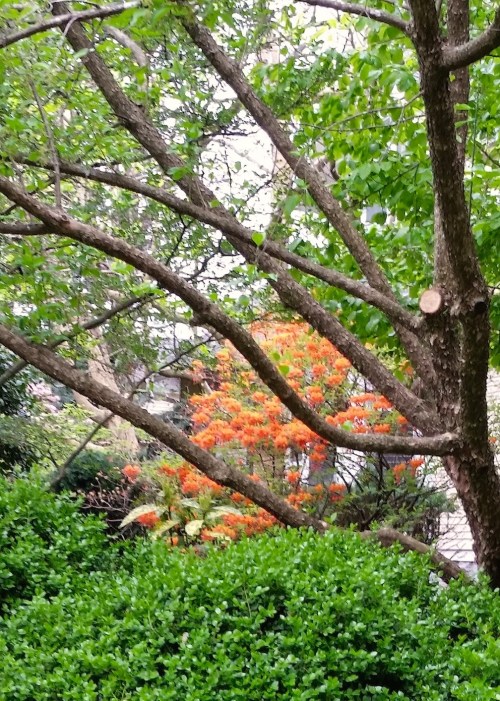
This spring I’ve taken hundreds of photographs for possible paintings later. The bright colors of blooms and light green foliage on the trees is irresistible. The photo above shows a Flame Azalea, which is a rhododendron, and also a native. I am partial to orange, a fun, and social color.

About Renee Bates

Renee is an artist focused on growing a newfound ability to express herself through oil painting, recently leaving her role as executive director of the non-profit, Greenways for Nashville. Renee is inspired by nature and enjoys hiking, birding, and the garden. She contributes to HerSavvy, a blog featuring writings from a group of well-informed women wishing to share their support and experience with others. Married to David Bates of Bates Nursery and Garden Center, enjoying flora and fauna is a family affair.

Leave a comment

Filed under Fun Savvy, Self Savvy

Building a Bottomless Bucket List


DOLPHIN PHOTO WILD SIDE_crop2_crop

This August I crossed one off the bucket list: swimming with dolphins.   Well, two actually, the second was riding a catamaran on the ocean.  I have wanted to sail again since I was eighteen, loving the exciting tipped on its side ride, tacking, and hearing the sound of the wind in the sails.  It was my cousin’s wooden sailboat at our local lake.  While the boat we were traveling on this day no longer sported the mast and white canvas, instead using engine power to traverse the surf, the excitement of negotiating the rolling waves was still there.  For snorkeling, I learned that big waves are not a big deal when you are in the deep water, as opposed to being beaten up with “the breakers” at the shoreline – on the water you just roll with it.  I did feel brave jumping into that water where big things live.  With flotation belt, mask, snorkel and fins, I was plenty well suited for braving this new world.

Our competent, ecologically respectful guide, Elizabeth, gave us thorough preparation and education about the dolphin’s feeding and rest cycles, and how they rest one side of their brain at a time, alternating between the sonar and analytical sides, as exhibited with closure of the opposing eye of the side of the brain which is asleep.  We learned how to visit in a low impact way and not chase or touch the docile and loving creatures.  A small group of three couples,  upon our first encounter we beheld about twenty dolphins as they played, rested, and lazily moved to and fro zigzagging the coast in their rhythmic movement, sometimes on the bottom, often on or near the top, in 40 to 100 feet of water.  We later noted in the car on the trip back to our hotel that each of us had been mesmerized by the Aurora Borealis-like shafts of light permeating down through the depths in glistening light patterns.  Adding to our pleasure were intensely warm water currents influenced by El Nino, followed by refreshing cool veins of sweet relief.  As an artist, I am looking more at how light reacts on objects, and the pieces of the shapes on those objects.   There was so much to see.

Hours later, I was still exhilarated with the excitement of it all, especially seeing the graceful dolphins in their home, and learning first hand about their loving, community nature.   As we moved from the snorkeling with dolphins site to the turtle site, the dolphins rode our bow, racing ahead as they are so adept at leading.  From the 2-week-old baby swimming against mom’s side, to the 4 teenagers “hanging loose” and swimming slowly, like teenagers do, we enjoyed every minute.  Others were exhibiting raucous, tail flapping fun, spinning, relaxing and mating.  It was nature at its best.  On the trip out we spotted sea turtles and flying fish.  On the way back to the dock, we stopped twice to swim with the turtles, getting good views of several adults together on the bottom coral.  I was at once surprised to be 5 feet away from a sea turtle as it emerged, so close I could smell its algae covered body or its breath; I’m not sure which.

Riding to and from the harbor was a great adventure on the high seas, better than a ride at Fair Park.  On the trampoline-like net across the front, I was holding on tight and getting splashed, rocking up, once airborne, and dropping back down again against the deep blue mountains of water as it splashed through the net.  It felt like we were at a rodeo.  I haven’t had that much fun in forever.

Extra special about this trip was getting to experience it with my soul mate, David, on our celebratory revisit, having married there on Oahu in 1985, one hour east and thirty years before that sun-filled day.

Next on the bucket list: getting up close to a humpback whale.  You will certainly hear about it as it happens.

Photo credit and company we explored with on Oahu: www.sailhawaii.com

About Renee Bates

Renee is an artist focused on growing a newfound ability to express herself through oil painting, recently leaving her role as executive director of the non-profit Greenways for Nashville to pursue art and product development.  Renee likes being in nature, hiking, birding, and working in the garden. Married to David Bates of Bates Nursery and Garden Center, a 3rd generation business begun in 1932. Renee admires the fact that it was begun by a savvy woman, Bessie Bates.  Renee’s art may be enjoyed from her website or followed on Facebook.

Like what you’ve read? Feel free to share, but please… Give HerSavvy credit. Thanks!

Leave a comment

Filed under Fun Savvy, Self Savvy

Flowers in the House: Hydrangea

Annabelle Hydrangea

Here’s your tip for bringing the outdoors in for entertaining. You may want to bring in the season simply for your own personal enjoyment. Be savvy and pluck stems from your landscape for an instant focal point for the table or powder room. There is no need purchase cut botanicals at the store, at least not all of the stems. Horticulture of any sort can be beautiful and your selections do not have to be flowering. Great foliage like oakleaf hydrangea, hosta, and my favorite – variegated Soloman’s Seal, work great for bringing in the green. I attended a lecture at the Antique and Garden Show a few years back when Dutch Master Florist Remco van Vliet spoke about floral arranging and conditioning flowers for longevity. Loving hydrangeas as I do, I took notes on his process. I have used the recommendations many times with success. This is what I’ve remembered and practiced for hydrangeas, and most every other stem: if cutting in the heat of summer collect them in the cool of the morning. Bring your water bucket out to the garden so there is little time between cutting and submerging. Strip the leaves off the stem, at least the ones that will ultimately be below the water line in the vase. Use extremely hot water (for hydrangeas). This opens the capillaries in the stem making the water uptake more effective. For all botanicals, cut the stems on the diagonal as this gives more surface for the stem to uptake water. Place damp paper towels on the heads of the flowers to help them stay hydrated through this process. After 45 minutes, change the water to cool and add a floral fresh conditioner. Arrange as desired. Change the water every couple of days to increase longevity. For any horticulture, it is a good idea to have no leaves in the water unless you are wrapping the stems with a cut hosta leaf or other interesting foliage in a transparent vase for decoration. For hydrangeas, on occasion I will have a stem that does not hold up and for no apparent reason. Oh, well, don’t worry about it. And a tip for that hosta and Soloman’s Seal, keep the leaves nice in the landscape by applying slug and snail killer every month, beginning early in the season.

About Renee Bates

Renee is an artist focused on growing a newfound ability to express herself through oil painting, recently leaving her role as executive director of the non-profit Greenways for Nashville to pursue art and product development. Today, June 16, is her “artist” anniversary, the day she happened upon the desire and ability to paint.  Renee likes being in nature, hiking, birding, and working in the garden. Married to David Bates of Bates Nursery and Garden Center, a 3rd generation business begun in 1932. Renee admires the fact that it was begun by a savvy woman, Bessie Bates.  Renee’s art may be enjoyed from her website or followed on Facebook.

Like what you’ve read? Feel free to share, but please… Give HerSavvy credit. Thanks!
2 Comments

Filed under Fun Savvy

Birding and BBQ, Perfect

Bates Birding hobby Jan 2015

Birding has been a hobby I have enjoyed since my late teens.  I thought that leaving our countryside home in 2007 to move into a dense city neighborhood would mean leaving frequent bird sightings behind, but I’m happy to say there are many birds here and I have even seen new varieties to add to my life list.  For instance, this winter I have seen a Golden Crowned Kinglet two different times near my bird feeder. I’m still waiting for a Rose-breasted Grosbeak to visit our yard, however.

For those wanting to see many bird varieties including the migratory 4’ tall Sandhill Cranes, and other birds whose habitat is in or near the water, I recommend going to Wheeler National Wildlife Refuge. Just an hour and forty five minutes down I-65, in Decatur, AL,  I’ve been told it has better viewing than the Soddy Daisy, TN site, and it’s a half hour closer.  I went to Wheeler on January 10th of this year and was thrilled to also see a pair of Whooping Cranes.  Most cranes are gone by mid-March, but with so many other birds to see, I think it would be a good place to visit at any time.  There is a good visitor center and an indoor viewing room where you can be out of the elements when needed.  It has walls of glass, a microphone mounted outside bringing the bird sounds in, and bleachers to sit on to enjoy the view.  We had a special treat as we watched a pair of bobcats on the far shore through a scope, soaking up the winter sun, playing and grooming.  Wheeler has walking trails and if you like to check out the local flavor, go into town about 3 miles and visit Big Bob Gibson’s BBQ Restaurant.  BBQ is my favorite food group and they did not disappoint with an extensive menu of sides as well.  For dessert they have delicious lemon meringue pie, among other sweets.

I’d love to hear what you are seeing at your feeder.

About Renee Bates

Renee is an artist focused on growing a newfound ability to express herself through oil painting, recently leaving her role as executive director of the non-profit Greenways for Nashville to pursue art and product development. Renee likes being in nature, hiking, birding, and working in the garden. Married to David Bates of Bates Nursery and Garden Center, she appreciates that the legacy of the 3rd generation business was begun in 1932 at the height of the depression by a savvy woman, Bessie Bates.

Like what you’ve read? Feel free to share, but please… Give HerSavvy credit. Thanks!

Photo:  Sandhill Cranes,

US Fish and Wildlife Service

Leave a comment

Filed under Fun Savvy

Considering George Washington

George Washington

At Presidents Day for 2015, radio host Barbara Dab interviewed attorney and historian Norma Shirk.  Enjoy!

About Barbara Dab:

Barbara Dab is a journalist, broadcast radio personality, producer and award-winning public relations consultant. She currently hosts two radio shows locally in Nashville, TN. Check out her website at http://www.zoneabouttown.com.

Barbara is also creator of The Peretz Project: Stories from the Shoah: Next Generation. Check it out at http://www.theperetzproject.com If you, or someone you know, is the child of survivors of the Shoah, The Holocaust, and would like to tell your story please leave a comment and Barbara will contact you.

Like what you’ve read and/or heard? Feel free to share, but please… Give HerSavvy credit. Thanks!

Leave a comment

Filed under Business Savvy, Fun Savvy

Homage to the Big Rigs (and their Drivers)


Big Rig 5

I love the big rigs. The more chrome and clearance lights the better. At night, rolling down the highway or tooling around a truck stop, they are more brilliant than a Christmas tree.  I love to listen to the raw power of a 500 or 600 horsepower motor.  I even like the noisy engine brakes because they are one of the greatest safety inventions ever on big rigs.

Big rigs provide instant metrics on the health of the economy.  The higher the number of big rigs on the road, the healthier the economy is because they deliver goods, including food, the “last mile” from the port, warehouse or railroad siding to the store.  Without them store shelves would be empty.  So when I inhale a lungful of diesel exhaust fumes from a big rig, I smile because I know the economy is humming along.

Despite their importance, I often hear people denigrating big rigs and their drivers. Trucks are deemed to be a dangerous nuisance on the highways and their drivers are stigmatized as uneducated bumpkins too stupid to get a “real” job.  But most drivers are hard-working men (and a few women) who are supporting their families. I know because I’m the daughter, sister, niece, and cousin of truck drivers.

Becoming a big rig driver requires studying federal safety regulations, passing the commercial driver’s license (CDL) exam, and undergoing two years over-the-road supervised training.  After that they endure a solitary life riding the nation’s highways and missing birthdays, anniversaries, holidays and their children’s school activities. Not surprisingly, is there is a growing driver shortage as fewer people enter this profession.

As to the charge that big rigs are dangerous, according to the American Trucking Associations, only 30% of highway accidents involving big rigs are caused by the truck drivers. That means 70% of the accidents are caused by the rest of us.  So here are a few basic safety tips.

  1. If you can’t see the truck’s mirrors, the driver can’t see you. Slow down, go around, or move in your lane until you can see your vehicle in the truck’s mirror.
  2. Signal your intentions early and avoid sudden movements. Basic physics informs us that 80,000 pounds needs more distance to slow to a stop than a 3000 pound car or SUV.  (Avoid flitting into the car-length’s space in front of the tractor.) The driver needs time to see you and prepare for what you plan to do.
  3. Never sit in the truck’s blind spots which include: immediately in front of the tractor (you can’t be seen over the hood); beside the fifth wheel where a trailer attaches to the tractor; beside the trailer’s rear axle; and immediately behind the trailer.

So the next time you pass a big rig on the road, join with me in paying homage to the big rigs. They keep the economy moving and their drivers are some of the hardest working people you’ll probably never meet.

About Norma Shirk

Norma started her company, Corporate Compliance Risk Advisor, to help employers create human resources policies for their employees and employee benefit programs that are appropriate to the employer’s size and budget. The goal is to have structure without bureaucracy.

Like what you’ve read? Feel free to share, but please… Give HerSavvy credit. Thanks!

1 Comment

Filed under Fun Savvy

The Other Side of the Couch – Happy Holidays?

Thanksgiving

I am sitting here this morning, Thanksgiving morning, and musing on the holiday expectations that we all bring to these times.  The picture of the Norman Rockwell family, gathered around the laden table, faces smiling in anticipation of the feast to come, is engrained in our collective psyche.  Magazines over the last month have been filled with recipes for “The Most Sumptuous, Easiest Thanksgiving Feast Ever.”  Methods for creating the perfect table setting, the perfect appetizer, the perfect pumpkin pie, abound.

I am one of the fortunate ones in that I do have a loving family and a family table to prepare.  Although I am not hosting the feast this year, I will be part of one.  And yet, I know all too well that these holidays often bring not joy, but turmoil and sadness to many.

So today, I am writing for those whose holidays are not filled with joy, whose family tables are filled with strife or silence or fear, who wait for the explosion, or the blows, or the criticism.  And for those who have no table, and who will go hungry, not only on this day, but on many others.  And for those who have no home, no place of warmth, no place to lay a weary head.  I am writing for the children who will be passed back and forth by acrimonious and angry parents, divorced, unconsciously still taking out their wars on their hapless children.  I am writing for the lonely ones, who will spend this day taking care of themselves the only way they know how…maybe by drinking too much, or eating too much.

I don’t have good answers for you.  These holidays are hard, and that is the truth.  In a culture filled with so much abundance, to be both physically and emotionally without resources is a hard blow to take.

So, rather than give you advice, I will tell you a story.

I was at my church’s regular Wednesday night dinner, and it happened to be the Thanksgiving celebration.  This was one of the coldest nights of the year in Nashville so far, going down into the teens, and because of this, our church had added extra nights of Room in the Inn.  The Room in the Inn guests came to the church dinner that night.  As it happened, part of the program was a presentation of a recent mission trip taken by adults from the church to a program in Guatemala that serves children and their families.

After the program, one of the Room in the Inn guests approached our senior minister, and handed him six dollars, requesting that this money go to help the children in the program he had just seen.  This man, homeless and down on his luck, gave the little he had to help a child who had less.

I happened to be standing next to them when this exchange happened, and I saw his face.  He was filled with emotion, and he was proud to be able to do something.  He regained some sense of himself as a man, a giver rather than a taker, in that exchange.

When we are in circumstances that we cannot control, when we are stuck in some situation that seems beyond help, sometimes we have to go outside a logical response.  That man knew that, for tonight, he had food, and a warm place to sleep, and would have breakfast in the morning.  He gave out of his abundance to someone who had less.  I am guessing that gesture changed his sense of himself.  Maybe there is a way we can think outside our boxes, too.

May your holidays be filled with compassion and awareness.

About Susan Hammonds-White, EdD, LPC/MHSP:

Susan is a communications and relationship specialist, counselor, Imago Relationship Therapist, businesswoman, mother, and proud native Nashvillian. She has been in private practice for over 30 years. As she says, “I have the privilege of helping to mend broken hearts.”

Like what you’ve read? Feel free to share, but please… Give HerSavvy credit. Thanks!

1 Comment

Filed under Fun Savvy, Self Savvy

Holidays for Savvy Cooks

Basket of Fruit and Pumpkin PieMy favorite holiday time of year is Thanksgiving.  It was Mom’s as well. “It’s all about the food,” Aunt Kathy pointedly told my mom with a grin, as they discussed an upcoming trip and Mom plotted their vacation by the restaurants they would dine in along the way.  Lella Mai (mom) certainly enjoyed good food, cooking and loving people with her creations from the kitchen.  My cousins loved Aunt Mai’s sweet tea, potato salad, corn bread dressing and chocolate confections.  From her “doctored up” Mississippi Mud Cake to her truffles and other deliciousness, desserts were top of mind.  Her first love, pound cake, was a constant entertainment as she tried many recipes.  I have found the same enjoyment in my own kitchen, especially creating new recipes, or tweaking others’ recipes to make them my own.

Mom was not one of those who kept secrets about her ingredients.  She would share recipes readily and was honored when people asked her for one.  She definitely had command of the kitchen.  Of course, everything else was under her leadership as well, but that’s another story.

The following salad is a recent discovery, and its simplicity makes it an easy addition to any meal.  Mom probably would not have liked this one because she never tasted arugula, to my knowledge, and she became fairly picky.  I can see her “would be” reaction to it now, a crinkled up nose in disapproval of the strong flavor.  It makes me laugh.  I do miss her.  She could make some awful faces.

This recipe serves 16-20 as an accompaniment and leftovers the next day are delicious.  Lemon is the standout and makes for a nice break on the palate between the savory goodness of turkey and dressing and that sweet potato casserole with the brown sugared crunchy topping.

Lemon Arugula Salad

  • 3 containers of arugula, organic if you can get it
  • 6 ounces thin sliced prosciutto di Parma, torn into small pieces
  • ½ cup of large shredded Parmigiano-Reggiano (use a large bit grater)

Dressing:

  • Juice of 2 lemons
  • 1/3 to ½ cup of good olive oil
  • Salt
  • Pepper

Mix the liquids and pour over the salad.  Sprinkle with salt and pepper. Toss well and serve.  Refrigerate leftovers.

Gathering family, cooking, eating, laughing and of course, expressing thanks, are all on the plan.  A nice walk in the woods, breathing in the crisp, cool air and walking off some of that deliciousness will be on the plan as well.

Happy Thanksgiving.

About Renee Bates

Renee is the executive director of the non-profit, Greenways for Nashville, a member based organization. In addition to growing private support for the trails and green spaces, she enjoys oil painting, hiking, nature and working in the garden. Renee is married to David Bates of Bates Nursery and Garden Center, a 3rd generation business begun in 1932 by a savvy woman, Bessie Bates.

Like what you’ve read? Feel free to share, but please… Give HerSavvy credit. Thanks!

2 Comments

Filed under Fun Savvy, Self Savvy